
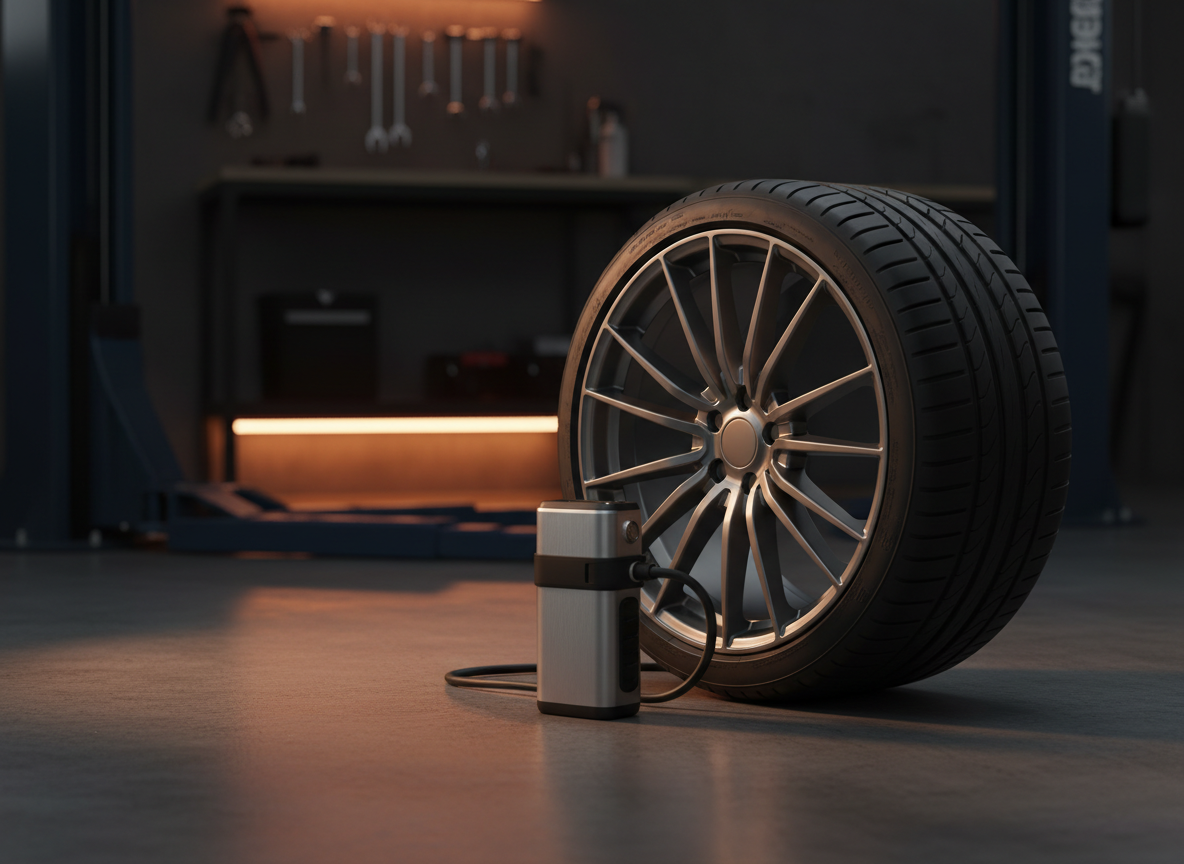
Updated September 21, 2026. Product listings, prices, availability and compatibility details can change. Verify the current seller listing before ordering.
Affiliate disclosure: RoadKitLab may earn a commission from qualifying purchases at no extra cost to you.
Fixing the leak does not restore the air. Adding air does not fix the leak.
VISUAL COMPARISON
Two tools, two different jobs

Heavy-Duty Tire Plug Kit
Feed price: €5.93
Job: certain repairable tread punctures.
Why buy: addresses the leak rather than just adding air.
Skip if: damage is outside the repair method’s safe use.

LEIBOO Wireless Tire Inflator
Feed price: €16.73
Job: restoring tire pressure.
Why buy: useful for top-ups and after an appropriate repair.
Main drawback: air alone does not make a damaged tire safe.
What the repair kit does
A suitable puncture-repair kit is intended to address certain repairable tread punctures. It is not appropriate for every type of tire damage, and roadside repairs may be temporary depending on the tire and method.
What the inflator does
An inflator restores air pressure. It can help with normal top-ups or after an appropriate repair, but it cannot make a damaged tire safe simply by adding air.
Simple roadside combination
Our latest feed included a tire plug kit at €5.93 and a LEIBOO cordless inflator at €16.73. Together they cover two different tasks for under €25 at that feed update—but only when the tire damage is appropriate for the repair method.
Full guide: Tire Repair & Roadside Tools.
More useful RoadKitLab guides
Roadside decision guide: what problem are you actually solving?
| Situation | Inflator | Repair kit | Best next step |
|---|---|---|---|
| Pressure is slightly low, no obvious damage | Useful | Usually not needed | Inflate to the vehicle-specified pressure and monitor. |
| Small puncture in the repairable tread area | Useful after an appropriate repair | May be useful if the method is suitable | Follow the kit instructions and arrange professional inspection. |
| Sidewall or shoulder damage | Does not make the tire safe | Do not treat as a normal plug repair | Use the spare or roadside assistance. |
| Pressure drops again after inflation | Temporary diagnostic help only | Depends on the cause | Stop treating repeated air loss as a simple top-up and have the tire inspected. |
| Large cut, visible cords, bulge or severe damage | Not a fix | Not appropriate | Do not continue driving on the damaged tire. |
The safety limit that matters most
A portable inflator can restore pressure, but pressure alone does not tell you that a tire is structurally safe. Likewise, a plug-style roadside kit is not a universal tire repair. Damage near the sidewall, large punctures, cuts, bulges or repeated pressure loss need a different response. Follow the tire and vehicle manufacturer’s guidance and treat roadside repairs as limited-use solutions when the repair method says so.
What to check when buying an inflator
- Power source: cordless models are convenient, while 12V models avoid relying on a charged internal battery.
- Hose and connector: make sure the fitting is practical for your wheel and valve position.
- Pressure display: easy-to-read controls matter more at the roadside than extra modes you may never use.
- Storage: the inflator should fit where you can reach it with the rest of the emergency kit.
What to check when buying a repair kit
- Confirm what type of puncture the kit is intended to address.
- Check whether the kit includes the insertion, reaming and trimming tools required by its own method.
- Read the instructions before an emergency instead of learning the process beside the road.
- Keep gloves and a pressure gauge or inflator with the kit so the repair process is not missing a second essential step.
30-second buying decision
- Choose an inflator first if your goal is routine pressure maintenance and top-ups.
- Add a repair kit if you understand its intended puncture type and want a roadside option for suitable tread punctures.
- Carry both if you want the tools to address a suitable puncture and then restore pressure.
- Do not rely on either for sidewall damage, major cuts, bulges or other serious tire damage.
FAQ
Can I just inflate a leaking tire and keep driving?
Inflation can restore pressure temporarily, but repeated pressure loss means the cause still needs to be found. Do not treat recurring air loss as a normal top-up.
Does a tire plug kit work on every puncture?
No. Plug-style kits are intended for specific puncture situations and are not a general solution for sidewall, shoulder or major structural damage.
Which tool should stay in the car?
An inflator has broader everyday usefulness because it can handle ordinary pressure top-ups. A repair kit adds value when the puncture is within the method’s safe scope and you know how to use it.
Roadside & tire guide map
- Roadside tool kit — broad trunk essentials by failure type.
- Emergency kit checklist — what to keep in the car.
- Tire repair & inflation tools — puncture and pressure-focused tools.
- Portable tire inflators — compare inflator options.
- Repair kit vs inflator — understand why they solve different problems.
- Road-trip accessories — breakdown gear plus travel comfort items.