
Updated September 22, 2026. Product listings, app support and compatibility can change.
Affiliate disclosure: RoadKitLab may earn a commission if you purchase through links on this page, at no extra cost to you.
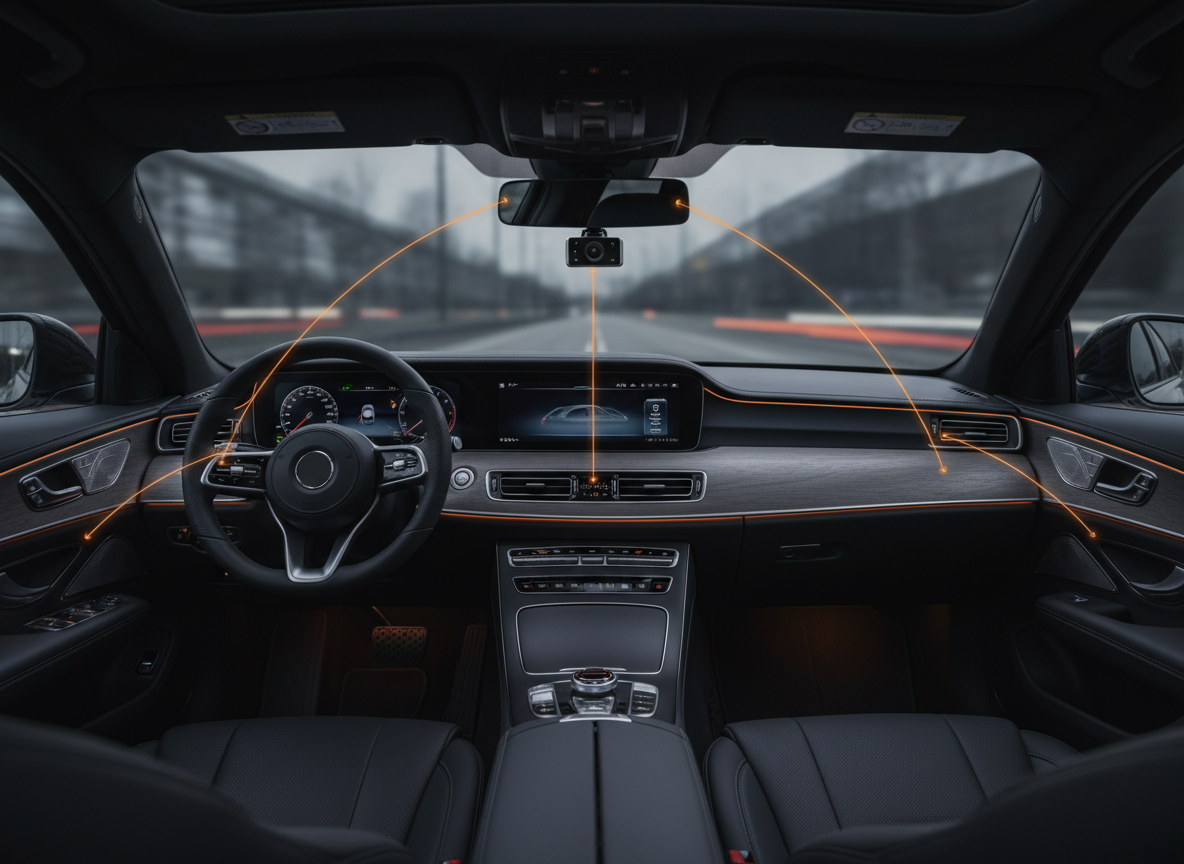
A third camera is useful only when you have a reason to record the cabin. If all you need is evidence of traffic ahead and behind, a good two-channel system may be simpler.
Three-channel systems make more sense for rideshare-style cabin coverage, family vehicles, commercial use cases or drivers who specifically want an interior record. RoadKitLab has not physically tested these cameras; features below come from current seller listings and should be verified before purchase.
Quick picks
- Best conventional 3-channel option: 70mai T800E
- Best mirror-format option: H330 3-Channel Rearview Mirror Dash Cam
- Best budget-oriented triple-camera format: 4K Triple-Camera Wi-Fi DVR
Quick comparison
| Dash cam | Format | Best for |
|---|---|---|
| 70mai T800E | Front + rear + interior | Conventional 3-channel coverage |
| H330 | Mirror-format 3-channel | Integrated display preference |
| 4K Triple-Camera Wi-Fi DVR | Conventional triple-camera | Budget-oriented comparison |
70mai T800E 3-Channel Dash Cam

Best for: Buyers wanting a conventional front + rear + interior setup.
Why consider it: The seller lists front, rear and interior recording together with GPS, parking functionality and a supercapacitor-based design.
Main drawback: Multiple channels create more files and increase storage demand.
Opens AliExpress • Verify the current seller listing, selected variant and compatibility before ordering.
H330 3-Channel Rearview Mirror Dash Cam

Best for: Drivers who prefer a mirror-integrated display format.
Why consider it: The rearview-mirror layout keeps the multi-camera display around the mirror area rather than adding a separate conventional screen.
Main drawback: Not every driver wants to change the normal rearview-mirror experience.
Opens AliExpress • Verify the current seller listing, selected variant and compatibility before ordering.
4K Triple-Camera Wi-Fi DVR

Best for: Buyers comparing lower-cost multi-camera systems.
Why consider it: The seller lists a three-lens format with Wi-Fi and parking-monitor features.
Main drawback: Verify simultaneous recording modes, app support and memory-card requirements rather than relying on the headline resolution.
Opens AliExpress • Verify the current seller listing, selected variant and compatibility before ordering.
Three channels vs four channels
A fourth camera is not automatically an upgrade. Three channels already cover the most common combination: front + rear + cabin. A four-channel system is more convincing when you can identify exactly what the fourth camera needs to capture.
What to check before buying
- Resolution per channel: do not assume a headline 4K claim applies to every camera simultaneously.
- Night performance: cabin footage can become much less useful if the interior camera struggles in low light.
- Storage: three simultaneous streams consume memory faster than one.
- Parking mode: check whether extra hardwiring or a separate power kit is required.
- Rear-camera cable length: larger SUVs and trucks can require more cable than small cars.
30-second decision
Choose a 3-channel camera if cabin recording has a real purpose. If cabin footage is unnecessary, spend the same budget on a stronger front/rear system. If you need broader coverage, compare RoadKitLab’s 3-channel vs 4-channel guide before adding another camera.
FAQ
Who needs a cabin camera?
It can be useful for rideshare, commercial driving or anyone who specifically wants an interior record.
Does more resolution always mean better footage?
No. Sensor quality, exposure, compression, lighting and implementation also affect usable footage.
Is three-channel installation difficult?
It is generally more involved than installing a single front camera because a rear camera requires additional cable routing.
Related RoadKitLab guides
Before choosing a 3-channel dash cam
- Confirm the third view: some systems use the extra channel for the cabin, while others position it differently.
- Check simultaneous recording quality: headline resolution may be shared differently across channels.
- Plan cable routing: rear and cabin cameras add installation work and should not interfere with airbags or visibility.
- Check memory-card requirements: three streams can consume storage faster than a single front camera.
- Decide whether parking recording matters: it may require a compatible hardwire kit or other power solution.
Who benefits most from three channels?
Three-channel systems are most useful when the cabin view answers a real need—rideshare work, fleet documentation, family or passenger context, or situations where front and rear road footage alone are not enough. If you only want road coverage, a simpler front + rear setup can reduce cost, wiring and storage demand.
Dash cam guide map
- Beginner buying guide — channels, recording, parking mode and storage.
- Dash cam roundup — compare specific camera formats.
- 3-channel vs 4-channel — choose how many viewpoints you need.
- 3-channel options — front, rear and cabin coverage.
- 4-channel guide — extra coverage, storage, power and installation.