
Updated September 23, 2026. Camera specifications, included accessories, parking features and storage support can change. Verify the exact listing before ordering.
Affiliate disclosure: RoadKitLab may earn a commission if you purchase through links on this page, at no extra cost to you.
A 4-channel dash cam can add useful viewpoints, but the fourth camera is valuable only when it covers a real blind area or recording need. More cameras also mean more wiring, mounting decisions, storage demand and power planning, so camera count alone is a poor reason to spend more.
Start with the coverage map
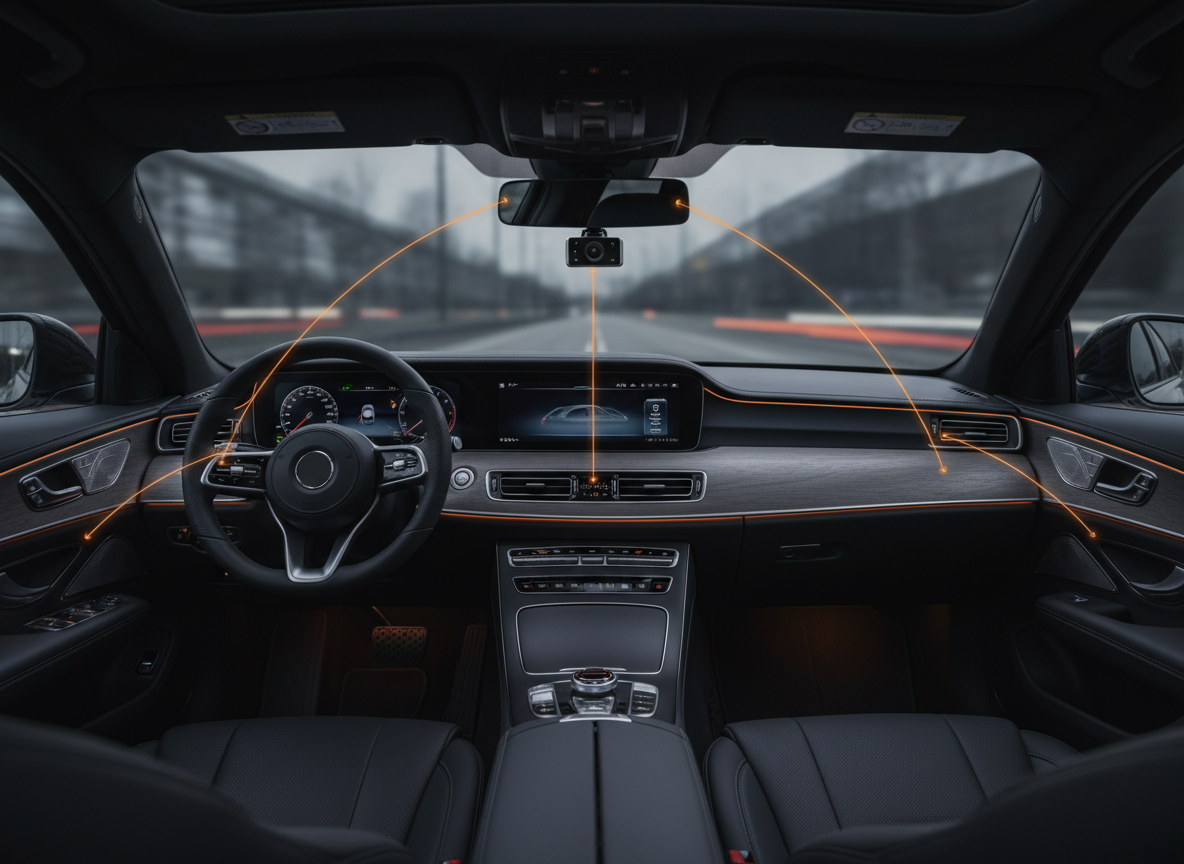
Before comparing products, decide what you actually want to record: front road, rear road, cabin, side windows or another exterior angle. Sketching the desired camera positions makes it easier to see whether three channels already solve the problem.
| Use case | Likely priority | Question to ask |
|---|---|---|
| Daily commuting | Front + rear | Does a fourth angle add meaningful evidence? |
| Ride-share / cabin recording | Front + rear + cabin | Do you also need a side or secondary exterior view? |
| Larger vehicle | Multiple exterior angles | Which blind area is not covered by a normal setup? |
| Parking monitoring | Coverage + power strategy | How will the system be powered while parked? |
What changes when you add more channels?
| Factor | Potential benefit | Tradeoff |
|---|---|---|
| More cameras | More viewpoints around or inside the vehicle | More wiring, mounting and installation time |
| More video streams | More context around an event | Higher storage consumption |
| Parking features | Potential recording while parked | Power management can become more complex |
| Multi-view playback | Can help reconstruct events | More files and footage to review |
Resolution labels need context
Do not assume every camera records at the headline resolution at the same time. Check the resolution of each channel during simultaneous recording, the codec, bitrate options and any frame-rate tradeoffs. The practical goal is readable, usable footage—not the largest number printed on the product image.
Storage planning matters
Four simultaneous streams can fill a memory card faster than a single-camera system. Verify supported card capacity, loop-recording behavior and how protected event files are handled. If you take long drives, storage management can matter as much as camera count.
Installation and parking mode
Plan cable routes before purchase. A multi-camera setup can require longer runs through trim, more mounting points and a cleaner power strategy. If parking monitoring matters, check whether the system requires a separate hardwire kit or another supported power arrangement.
4-channel option to inspect
When three channels may be enough
If front, rear and cabin coverage already capture the areas that matter to you, the fourth channel may add cost and complexity without solving another problem. Compare our 3-channel vs 4-channel guide before deciding.
4-channel buying checklist
- Decide the exact four viewpoints you want.
- Verify resolution for each channel during simultaneous recording.
- Check supported storage capacity and card requirements.
- Plan cable routes and mounting positions.
- Verify parking-mode power requirements.
- Check what cameras, cables and mounts are actually included.
FAQ
Does four-channel mean every camera records at the same resolution?
Not necessarily. Verify the specification for simultaneous recording on the exact variant.
Will more cameras use more storage?
Generally yes, because more video streams are being recorded. The exact impact depends on resolution, bitrate, codec and settings.
For alternatives, see our 3-channel dash cam guide, dash cam roundup and High-Ticket Car Gear hub.
Dash cam guide map
- Beginner buying guide — channels, recording, parking mode and storage.
- Dash cam roundup — compare specific camera formats.
- 3-channel vs 4-channel — choose how many viewpoints you need.
- 3-channel options — front, rear and cabin coverage.
- 4-channel guide — extra coverage, storage, power and installation.